

Pages that AI tools cite are almost three times more likely to have JSON-LD schema on them. You’ve probably seen that number in a LinkedIn carousel. I’ve seen it in at least four.
The problem? It’s a correlation. When Ahrefs went back and tested whether adding schema actually caused more AI citations, the needle barely twitched.
Schema markup is code that labels page content, such as your business name, author or price, so machines can read it as facts. Some of it still pulls its weight. A lot of what’s being sold around it right now is hype.
Schema markup does not directly give a boost to your AI citations. Ahrefs tracked 1,885 pages that added schema and saw no clear boost in ChatGPT or Google AI Mode visibility. Google says no special schema is needed for AI Overviews. However, schema helps machines identify your business, adds to rich results, and helps Bing’s Copilot understand pages.
Does schema markup help you get cited by AI?
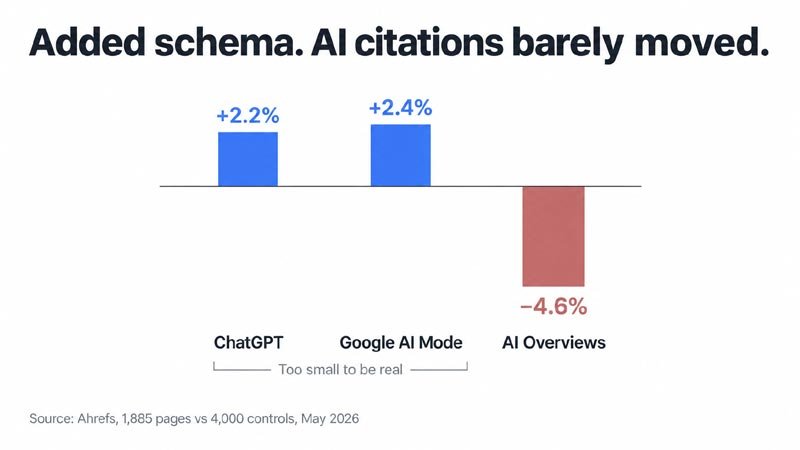
Not directly, no. The best test we have found no clear difference in AI citations after pages added schema.
Ahrefs ran it in May 2026. Louise Linehan and Xibeijia Guan took 1,885 pages that added JSON-LD between August 2025 and March 2026, then matched them against 4,000 pages that never did.
ChatGPT citations went up 2.2%. AI Mode, 2.4%. Both numbers are small enough to be noise. And AI Overviews? Down 4.6%.
“Adding schema produced no major uplift in citations on any platform.” Louise Linehan, Content Marketer at Ahrefs, in the Ahrefs schema study
So why do cited pages have more schema in the first place? Because the sites that bother with schema usually bother with everything else too. Better content, better links, cleaner code. Schema is along for the ride.
I think of schema as plumbing. Your house needs it. Nobody buys the house because of the pipes.
(We post more tests like this on the TrainingWale blog, if you like this kind of thing.)
Do ChatGPT and other AI tools read schema markup?
Mostly not when they fetch a page live. They read the text a human would see.
searchVIU checked this with ChatGPT, Claude, Perplexity, Gemini and Google AI Mode. All five pulled visible HTML. None of them used the JSON-LD.
Bing is the one exception anyone has confirmed on record. At SMX Munich in March 2025, Microsoft’s Fabrice Canel said schema helps Bing’s LLMs understand content, as Search Engine Roundtable reported. Copilot sits on top of Bing’s index, so if your buyers use Copilot, that’s worth knowing.
Google hasn’t been vague either. Its AI features guide says there’s no special schema needed for AI Overviews or AI Mode. The one ask is that your structured data matches what’s on the page.
Which brings me to the part people skip. If the answer isn’t written in plain text on your page, no amount of markup will save it.
Which schema types still matter in 2026?
Organization, LocalBusiness, Person, Product and Article schema are still worth adding. They tell search engines who you are, and a few still trigger rich results.
| Schema type | What it tells machines | Still worth adding? |
|---|---|---|
| Organization | Brand name, logo, social profiles via sameAs | Yes, do this one first |
| LocalBusiness | Address, phone, hours, service area | Yes, if you serve a city |
| Person (author) | Who wrote the page and their background | Yes, on blog posts |
| Product and Review | Price, stock, ratings | Yes, for ecommerce |
| Article | Headline, dates, author | Yes, easy to implement. Built in CMS |
| FAQPage | Question and answer pairs | Optional. Google dropped the rich result in May 2026 |
The real value is entity clarity. Think about 2 coaching institutes in Hyderabad with almost the same name. Organization and LocalBusiness schema, when done properly, tells Google and Bing which one is which, down to the address and the YouTube channel.
What schema advice is mostly hype?
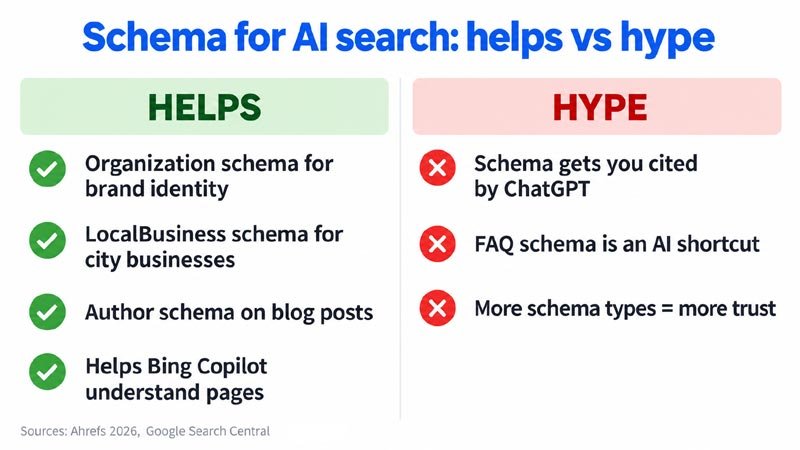
Anything that says schema update can get ChatGPT to cite you. Any SEO agency selling FAQ schema as an ground breaking AI trick to boost your AI citations.
Start with FAQ schema, because it’s the one I get asked about most. Google stopped showing FAQ rich results on May 7, 2026. And AI tools read your visible FAQ section as normal text anyway, markup or no markup.
This one is common too – “AI needs JSON-LD to understand you”. The searchVIU test says otherwise. Good headings and a direct first sentence do more for an AI reader than any script tag.
The third one makes me smile. Some audits I review have 12 or 15 schema types stacked on a single page, as if trust comes by volume. It doesn’t. Markup that doesn’t match the page can actually break Google’s guidelines.
Should you go and delete your old FAQ schema? Don’t bother. Google says unused markup causes no harm.
A Hyderabad client once paid an agency to add FAQ schema to 200 thin pages, on the promise of ChatGPT visibility. I will not reveal the name here but six months later, AI mentions hadn’t moved at all. During a meetup session we discussed this and saved the client from futher wait and high expectations.
We rewrote 20 of those pages so each one opened with a straight answer. We also got the brand into two industry listicles. That’s when ChatGPT started naming them.
How should you use schema for AI search in 2026?
Get the basics right, then stop. Spend most of your time on content and getting talked about on other sites.
This is roughly the order I use with clients:
- Organization schema on the homepage. Add your logo and sameAs links to LinkedIn, YouTube and your Google Business Profile.
- LocalBusiness schema, if you serve a city. Copy the address and hours exactly as they appear on your Google Business Profile.
- Article and Person schema on blog posts. Point each author to a real bio page, not a blank one.
- Cross-check values you add in schemas with the visible page. If the schema says one price and the page says another, then you have an issue. Fix it ASAP.
- Validate at validator.schema.org. Google’s Rich Results Test doesn’t check FAQ markup any more.
- Move on. Answer-first content and third-party mentions are what earns you an AI citations.
If you want the content side in more depth, our guide on AEO vs GEO vs SEO picks up from here.
Honestly, when I train SEO teams at TrainingWale in Hyderabad, schema gets a short slot. People expect me to spend more time and put more emphasis to this, but that is not required.
Key Takeaways
- Ahrefs found adding schema to 1,885 pages produced no clear AI citation lift.
- AI tools read visible text(mostly) and skip JSON-LD during live fetches.
- Google says AI Overviews and AI Mode need no special schema.
- Organization and LocalBusiness schema do help with entity clarity and Bing Copilot. Do it anyway.
- FAQ rich results ended on May 7, 2026. FAQ schema is no longer an AI shortcut but people will not listen.
Frequently Asked Questions
Does adding schema markup help my website show up in ChatGPT answers?
Not directly for ChatGPT, but it may be required for many other factors like local search etc. An Ahrefs study of 1,885 pages found no clear citation lift in ChatGPT after adding schema. Focus on visible, answer-first content and brand mentions.
Is FAQ schema still useful in 2026?
FAQ schema has little value for Google now, theoretically. FAQ rich results stopped showing on May 7, 2026. You can leave existing markup in place. As per Google, unused markup causes no problems. Keep the visible FAQ section, since AI tools read that text.
Which schema should a small business add first?
A small business should add Organization and LocalBusiness schema first. These confirm your name, address, logo, and social profiles. Make sure every detail matches your Google Business Profile.
Does Google need structured data to show my site in AI Overviews?
No, Google says no special structured data is required for AI Overviews or AI Mode. Your page only needs to be indexed and eligible for a normal snippet. Any schema you add should match the visible text.
Curious which parts of AEO and GEO actually move results, and which are just noise? That’s what we test in TrainingWale’s hands-on 5-day AEO and GEO sprint in Hyderabad, on a real business. Details are on the TrainingWale website.
