

Last updated: 17th October 2026. The prices were checked on each vendor’s official pricing page in October 2026. None of the vendors paid for the article to be featured, and the article contains no affiliate links.
Your rankings can look fine while your brand quietly disappears from AI answers.
The gap exists today. When Ahrefs examined 300,000 keywords it was found that AI Overviews reduced the click-through rate of the top result by 58%. At DevDay 2026, OpenAI stated that ChatGPT has 1.2 billion users per week, and at I/O 2026 Google said that AI Overviews had reached 2.5 billion monthly users.
Thus the question has changed; it is no longer just ‘Do we rank?’ but ‘Do AI tools mention us, cite us, and recommend us above our competitors?’
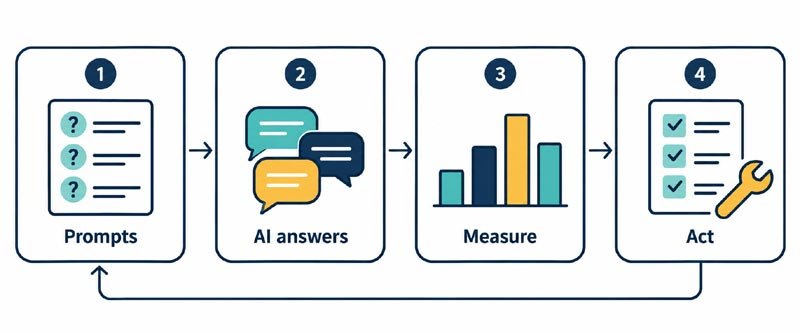
AI visibility tools provide an answer to that question. We looked at the pricing pages, the help documents, the integration lists and the plan limitations of ten popular tools. After that we evaluated each of them on six weighted criteria. Here is what the data shows.
The short answer
- Best overall: Peec AI (score 88/100)
- Best if you already pay for Semrush: Semrush AI Visibility Toolkit (78.5)
- Best budget start: OtterlyAI, from $29/month (77.5)
- Best free plan: AthenaHQ, free with 300 credits (77)
- Best for large enterprises: Profound (75.5)
- Best pay-as-you-use pricing: ZipTie, $0.01 per check (72.5)
What’s in this guide
- Key numbers from our research
- How we scored the tools
- Final scores at a glance
- Comparison table
- The 10 best AI visibility tools, reviewed
- What these tools really cost
- Which AI engines get tracked
- How to choose the right tool
- A 7-step trial checklist
- FAQs
Key numbers from our research
The following are the patterns that appeared in all 10 of the tools-they are based on our own count of what each provider publishes.
The figure I just mentioned came as a surprise to us. We’ll go into more detail on that later. For the moment, the point to take away is clear: don’t believe the price stated in the headline or the number given for the engine until you see it on the checkout page.
How we scored the tools
We selected 10 tools that repeatedly appear in buyer research for this category and then consulted the source. For each tool we looked at the official pricing page, the product pages, the help centre, the list of integrations and the plan limitations.
We never relied on review sites or spoke to the vendors in order to obtain the scores. If a feature or a price had not been published, we did not award any credit for it either. We also never made an educated guess.
On each of the six criteria the tools received a mark out of 10, the criteria having been given weights according to their importance to an average marketing team.
| Criterion | What we checked | Weight |
|---|---|---|
| Measurement depth | Mentions, position, citations, sentiment, share of voice, competitor and source data | 25% |
| Actionability | Does it tell you what to fix? Content, PR, technical or commerce actions | 20% |
| Engine coverage | Named AI platforms, regions, languages, history | 15% |
| Workflow fit | Exports, API, MCP, Looker Studio, GA4, GSC, CMS and CDN links | 15% |
| Pricing clarity | Public prices, quotas, trials, and whether pages agree with each other | 15% |
| Audience fit | How useful it is for SEO pros, agencies and in-house teams | 10% |
One limitation: the scores are based on the capabilities that have been published. They do not serve as a measure of the accuracy of the answers. The answers given by the AI vary from one run to another. Therefore no tool can display a fixed ‘truth’. Each company in this list states something similar in its own documentation.
Final scores at a glance
Chart 1: Weighted score out of 100
If you look at the middle of the chart, the spots numbered two to five are all within three points of one another. This indicates that the ‘best’ tool in that range will depend more on your particular situation than on the score. Therefore a customer of Semrush and a Fortune 500 company should not purchase the same product.
Here’s the full breakdown, so you can re-weight it for your own needs.
| Tool | Depth (25%) | Action (20%) | Coverage (15%) | Workflow (15%) | Pricing (15%) | Fit (10%) | Total |
|---|---|---|---|---|---|---|---|
| Peec AI | 9 | 8 | 9 | 9 | 9 | 9 | 88 |
| Semrush AI Toolkit | 8 | 7 | 6 | 9 | 8 | 10 | 78.5 |
| OtterlyAI | 8 | 7 | 6 | 8 | 9 | 9 | 77.5 |
| AthenaHQ | 8 | 9 | 9 | 8 | 5 | 6 | 77 |
| Profound | 10 | 9 | 9 | 8 | 2 | 4 | 75.5 |
| ZipTie | 8 | 7 | 7 | 7 | 7 | 7 | 72.5 |
| Writesonic GEO | 7 | 8 | 7 | 8 | 6 | 6 | 71 |
| Ahrefs Brand Radar | 7 | 5 | 7 | 7 | 7 | 7 | 66 |
| Scrunch AI | 8 | 6 | 6 | 7 | 6 | 5 | 65.5 |
| RankScale AI | 7 | 5 | 8 | 6 | 5 | 6 | 62 |
Notice Profound has the highest depth score among the others. It ranks fifth since there is no public dollar price for a continuing plan. If budget isn’t an issue for you, then you should put it higher on your list.
Comparison table
| # | Tool | Best for | Entry price (as listed) | Engines named | Free plan or trial |
|---|---|---|---|---|---|
| 1 | Peec AI | Best overall balance | $95/mo | 12 | Check pricing page |
| 2 | Semrush AI Visibility Toolkit | For current Semrush users | $99 per month per domain, with annual billing | 5 | There is no free trial |
| 3 | OtterlyAI | Budget, self-serve | $29/mo | 7 (4 in base) | Free trial |
| 4 | AthenaHQ | Free start, action workflows | Free; Starter $295/mo | 11 | Free plan (300 credits) |
| 5 | Profound | Enterprise depth | Custom | 10 | 7-day trial |
| 6 | ZipTie | Usage-based pricing | From $42.75/mo | 7 | 7-day trial |
| 7 | Writesonic GEO | Content-led teams | $79/mo, billed annually | 8 | Check pricing page |
| 8 | Ahrefs Brand Radar | Search demand context | $199/mo (Brand Radar AI) | 7 | Check pricing page |
| 9 | Scrunch AI | Technical and AI agent layer | $250/mo | 9 (4 in Core) | 7-day trial |
| 10 | RankScale AI | Broad coverage, low entry price | $20/mo ($17 yearly) | 11 named (17+ claimed) | Check pricing page |
The number of engines listed refers to those named by each vendor on its own pages, including any add-ons. If ‘check the pricing page’ is stated, it means that we did not come across a trial clearly mentioned in the pages we looked at.
The 10 best AI visibility tools, reviewed
1. Peec AI: best overall
Score: 88/100
Peec AI won since it does almost everything well and conceals almost nothing; that quality is rarer than it appears in this area.
You receive prompt-level tracking relating to visibility, position, sentiment, and share of voice, and the report also shows which sources and citations the AI engines rely on. It then takes it a step further by grouping the opportunities, suggesting actions, checking AI Shopping visibility, and carrying out a crawl audit for over 40 AI bots.
The company offers the most transparent pricing among the others, with both brand plans and agency plans available to the public and the annual prices displayed alongside the monthly ones.
The engines mentioned are ChatGPT, Google AI Overviews, AI Mode, Perplexity, Gemini, and Copilot; the add-ons are Claude, DeepSeek, Qwen, Grok, Mistral and the OpenAI Search API.
Integrations: CSV, Looker Studio, REST API, MCP, Cloudflare, Vercel, WordPress, Akamai, AWS CloudFront, GA, Shopify, and Merchant Center.
Best for: In-house SEO and content teams, and agencies that report to several clients.
Be careful about the following: the lower tiers restrict the models that are available to you. For some models an extra charge applies. Crawl insights will only function if you are able to share the server logs. Peec also states that its browser-based approach captures answers that differ from run to run, a fact which is honest and true of every tool listed here.
2. Semrush AI Visibility Toolkit: best for existing Semrush users
Score: 78.5/100
Should your team have already set up their accounts in Semrush, then this option is the straightforward one. The AI data is located alongside Position Tracking, Site Audit and My Reports and you won’t need to create a new login or develop a new routine for reporting.
The toolkit includes a visibility overview, competitor research, prompt research, sentiment analysis, and share of voice; it also features an AI Search Site Audit, which is useful when you want to check technical blockers together with visibility.
Engines named: ChatGPT, Google AI Overviews, AI Mode, Gemini, Perplexity.
Integrations: My Reports, Position Tracking, Site Audit, GA and GSC via paid reports, together with 20 or more external integrations on the paid tier.
Best for: SEO and marketing teams that want AI visibility inside their existing SEO stack.
Be careful: the standard plan is crowded in. It features one project, one domain, 25 tracked prompts, 100 Site Audit pages and 10 CSV exports each day. This amounts to $3.96 per tracked prompt monthly. Semrush refers to the metrics as “directional” because its prompt datasets do not capture every actual conversation.
3. OtterlyAI: best budget pick
Score: 77.5/100
OtterlyAI is the best option for most small teams since it costs only $29 per month and is the second cheapest paid service on this list-it’s not a toy.
You are provided with prompt research, brand and URL citation tracking, competitor reports, sentiment and GEO audits; the higher-tier plans also include query fan-out, agent analytics, API and MCP access and you receive the Semrush app along with a Looker Studio connector.
Engines named: ChatGPT, Google AI Overviews, Perplexity, Copilot in base plans. Claude, AI Mode and Gemini are paid add-ons.
Integrations: Looker Studio, the public API, MCP, the Semrush app, the GA4 referral template, and exports in CSV, JSON and PDF format.
Best for: Freelancers, solo marketers, small agencies and SMEs moving from manual checks to real tracking.
Be careful: the base plans cover only four engines and its own website is unclear about whether the free trial lasts for 7 or 14 days. Make sure to verify the exact duration before you plan your test.
4. AthenaHQ: best free plan
Score: 77/100
AthenaHQ scored 9 on actionability, tied with Profound for the top mark. It treats tracking as step one, not the whole job.
It goes beyond simply noting mentions, carrying out citations and measuring share of voice by identifying citation gaps in relation to its competitors; it recommends specific content and public relations actions, helps with Shopify optimisation and provides governance features for larger teams. The tool also lists 11 AI engines, which is the largest number mentioned here.
Engines named: ChatGPT, Perplexity, Google AI Overviews, AI Mode, Gemini, Claude, Copilot, Grok, DeepSeek, Meta AI, Mistral.
Integrations: GA4, GSC, Google Ads (connection only), Shopify, WordPress, Webflow, Contentful, Sanity, Framer, Wix, Looker Studio, Slack, API, MCP.
Best for: Teams that want to turn visibility gaps into content, PR and commerce work.
Be aware that: the increase from free to $295 is steep, it is in fact the largest gap between free and paid versions in this list, full model coverage is restricted by tier, the Starter tier is limited to just one country, and the Google Ads link currently does not retrieve campaign or keyword data.
5. Profound: best for enterprises
Score: 75.5/100
On pure depth, Profound beats everyone here. It scored a perfect 10 on measurement.
The tool incorporates data on prompt volume, citations, sentiment and competitor benchmarks together with analytics from an AI crawler and referral data; it also monitors ChatGPT Shopping and includes agent workflows for content. Profound states that its data is based on the real consumer experience rather than just on API outputs, since API responses can differ from what users actually see.
Engines named: ChatGPT, Perplexity, Claude, Gemini, Copilot, Google AI Overviews, AI Mode, DeepSeek, Grok, Exa.
Integrations: Google Ads, OpenAI Ads, the major CDNs and CMSs, GA, GSC, Looker, Slack, Notion, Drive, Teams, Linear, and the API.
Best for: Large brands and agencies with budget and a formal buying process.
Be aware that: the trial is limited in scope; it has no history, no exports and no API. Therefore, it’s not really possible to assess trends over a seven-day period, and you can expect to receive a sales call before you encounter the actual price.
6. ZipTie: best pay-as-you-use pricing
Score: 72.5/100
ZipTie charges according to usage; you are charged $0.01 for each prompt-engine check. Therefore, using 100 prompts with three engines, each checked once, will cost approximately $3 for basic usage.
The model is appropriate for teams aiming to have tight control over their spending. The AI Success Score combines the citation rate, the mention rate and the sentiment into a single figure. It keeps the complete AI answers along with the cited URLs and also displays the Google Search Console data alongside the AI data, enabling you to connect the two.
Engines named: ChatGPT, Google AI Overviews, AI Mode, Perplexity, Copilot, Bing AI Overview, Gemini.
Integrations: Google Search Console, REST API, MCP, import via CSV, exports in CSV, XLSX and PDF format, and the ability to share links.
Best for: Agencies and SEO teams that want an action queue and spend control.
Be careful about this: none of the tiers have a tendency to make comparisons more difficult. The add-ons accumulate quickly. Also, ZipTie does not provide content publication to your site.
7. Writesonic GEO: best for content-led teams
Score: 71/100
Writesonic began off as a writing tool and its GEO product retains that characteristic. It brings together daily visibility tracking with content briefs, citation fixes and technical actions all in one place.
The tracking function includes prompt answers, competitors, share of voice, cited pages, opinion and market targeting; it also keeps an eye on the ads in AI answers. The list of integrations is lengthy and includes among others WordPress, Sanity, Contentful, Drupal, GA4, GSC and Ahrefs.
Engines named: ChatGPT, Perplexity, Claude, Gemini, Grok, Copilot, AI Mode, Google AI Overviews.
Integrations: WordPress, Sanity, Contentful, Contentstack, Drupal, Vercel, CDNs, GSC, GA4, Ahrefs, Looker, MCP, API, and webhooks.
Best for: Content and SEO teams that want tracking and writing in one product.
Be aware that: the lower brand levels cover only three platforms-ChatGPT, Gemini, and AI Overviews. The website sometimes states that there are 8, 9, or 10 or more platforms in total. We have only counted the ones it explicitly mentions.
8. Ahrefs Brand Radar: best for search demand context
Score: 66/100
Unlike most of the other tools available here, Brand Radar operates by first using a big AI Visibility Index, which enables you to browse mentions and cited domains on a large scale, and then you can add Custom Prompts to set up a more limited watchlist.
The true value lies in Ahrefs’ search data since it allows you to see the AI share of voice alongside search demand, web visibility and even the number of views on YouTube, Reddit and TikTok videos. For SEO teams, that kind of context is invaluable.
Engines named: Google AI Overviews, AI Mode, ChatGPT, Perplexity, Gemini, Copilot. Claude through Custom Prompts only.
Integrations: Looker Studio (for the Advanced plan and above), Ahrefs API.
Best for: SEO teams already on Ahrefs who want discovery plus a focused prompt list.
Be aware that: it received the lowest rating for actionability according to RankScale since it tells you your current position but does not encourage you to move on to the next solution. Ahrefs has also halted its new Grok data collection.
9. Scrunch AI: best for the technical and AI agent layer
Score: 65.5/100
Scrunch goes beyond just providing answers; it monitors the way AI bots crawl your site and the amount of AI referral traffic that ends up in GA4. It also includes Agent Pages, which offer AI-friendly versions of your content at the edge.
No other tool extends its capabilities so far in terms of delivery. That’s a significant point if your team manages the CDN and the hosting.
Engines named: ChatGPT, Gemini, AI Mode, AI Overviews, Perplexity, Claude, Copilot, Grok, Meta AI. Core lists four.
Integrations: Akamai, Cloudflare, Vercel, WordPress, GA4, the Query, Responses and Agent Traffic APIs, MCP, and Looker Studio.
Best for: Brands with technical owners who can connect CDN and GA4 data.
Be aware that: Core includes 4 engines even though the platform lists 9. Setup is required for Agent Traffic. The annual and overage prices are not published.
10. RankScale AI: best broad coverage at a low price
Score: 62/100
RankScale has the lowest monthly fee of $20 on this list and also states that it has 17 or more engines, the largest number mentioned here.
The list of features is also extensive, including rank and citation tracking, sentiment and competitor detection, query fan-out, AI readiness audits, shopping and ads analysis, white-label reports, API and MCP.
Engines named: ChatGPT, Gemini, AI Mode, AI Overviews, Perplexity, Claude, Copilot, DeepSeek, Grok, Mistral, Meta Muse Spark.
Integrations: Looker Studio, GA4 (beta), GSC (beta), REST API, MCP.
Best for: Agencies and multi-brand teams that want low-cost, broad monitoring with white-label reports.
Be careful about the following points: we were able to identify only 11 of the more than 17 engines listed. The pricing cards and the page metadata are not the same. The way API access is displayed differs between the plan card and the comparison table. Make sure you get a written confirmation before making the purchase.
What these tools really cost
Headline prices mislead in this category. Here’s why, with numbers.
Chart 2: Lowest published paid plan per month (USD, monthly billing where shown)
$20
$29
$42.75
$79
$95
$99
$199
$250
$295
*Price shown is billed annually. AthenaHQ also has a free plan. Ahrefs also sells Custom Prompt packs from $50/mo.
The cheapest paid plan costs $20. The priciest published one costs $295. That’s almost 15 times more. But the plans don’t measure the same thing, so price alone tells you little.
Unit cost: what you actually pay for
Each vendor sells a different unit. Some sell prompts. Some sell checks. Some sell credits. We did the math where the vendor publishes both price and quota.
| Tool and plan | What you get | Unit | Cost per unit |
|---|---|---|---|
| Semrush Base ($99) | 25 tracked prompts | Prompt/month | $3.96 ($1.20 for extra packs) |
| Scrunch Core ($250) | 125 prompts, 5,000 responses | Prompt/month | $2.00 ($0.05 per response) |
| AthenaHQ Starter ($295) | 3,600 credits | Credit | $0.082 |
| Ahrefs Brand Radar AI ($199) | 2,500 checks | Check | $0.080 |
| Ahrefs Custom Prompts overage | Pay per extra check | Check | $0.010 to $0.020 |
| ZipTie | Pay per prompt per engine | Check | $0.010 |
A prompt generally refers to a single question that is tracked over time and across different engines and dates, while a check consists of a single question on one engine carried out once. Therefore, at $2 per prompt it can be less expensive than $0.08 per check if the prompt is run each day on a number of engines. It is necessary to convert to the same unit before making a comparison.
Annual billing saves 14% to 17%
Five tools show both monthly and annual prices. The savings land in a tight band.
- Peec AI: 15% to 16% off (for example, $95 drops to $80)
- OtterlyAI: 14% to 15% off ($29 drops to $25)
- AthenaHQ: 17% off, as stated
- RankScale AI: 15% off ($20 drops to $17)
- Semrush and Writesonic: entry prices are shown as billed annually
We recommend that you pay on a monthly basis for the first two or three months and only move to an annual payment afterwards once you’ve found the tool to be useful.
The entry plan coverage gap
This is the trap most buyers miss. Cheap plans often track far fewer engines than the homepage suggests.
| Tool | Engines on entry plan or trial | Engines named overall |
|---|---|---|
| Writesonic GEO (lower tiers) | 3 | 8 |
| Profound (trial) | 3 | 10 |
| ZipTie (trial) | 3 | 7 |
| OtterlyAI (base plans) | 4 | 7 |
| Scrunch AI (Core) | 4 | 9 |
On their entry plan or trial five of the ten tools have reduced the amount of coverage offered, and Scrunch Core has less than half of its complete range. If your audience values Claude or Copilot, make sure that these are included before making a payment.
Which AI engines get tracked
We counted the number of the 10 tools that give the name of each AI engine on their individual pages; the results show the areas in which the market agrees and those in which it does not.
Chart 3: Number of tools (out of 10) that track each engine
The engines which are available as paid add-ons or custom prompts are included. Among the tools listed, Semrush is the one that does not have Copilot and Semrush and ZipTie are the two that don’t have Claude.
At this point having five engines is just the minimum requirement and all the tools monitor them; beyond that the level of coverage drops off rapidly, with only four tools keeping an eye on DeepSeek and only three monitoring Meta AI or Mistral.
Therefore, there’s no need to pay extra for a long list of engines unless the people who buy the product make use of those engines. For most brands, the core five together with Copilot and Claude meet the majority of AI search needs.
Other features, by the numbers
- Looker Studio connection: Eight out of ten tools use Semrush’s My Reports, while ZipTie depends on exports and share links.
- MCP support: 7 of 10 (Peec, OtterlyAI, AthenaHQ, ZipTie, Writesonic, Scrunch, RankScale).
- Shopping or commerce visibility: 5 of 10 (Peec, Profound, AthenaHQ, Scrunch, RankScale).
- AI bot or agent traffic analytics: 4 of 10 (Peec, Profound, OtterlyAI, Scrunch).
- Self-contradicting official pages: 6 of 10 (OtterlyAI, Writesonic, Ahrefs, Scrunch, RankScale, Semrush).
That point warrants a bit of discussion. We discovered mismatches concerning trial length, engine counts, platform names and price metadata. Nothing seemed suspicious. Since these products change on a monthly basis and their pages are slow to update, it is nevertheless a good reason to verify the details in writing.
How to choose the right tool
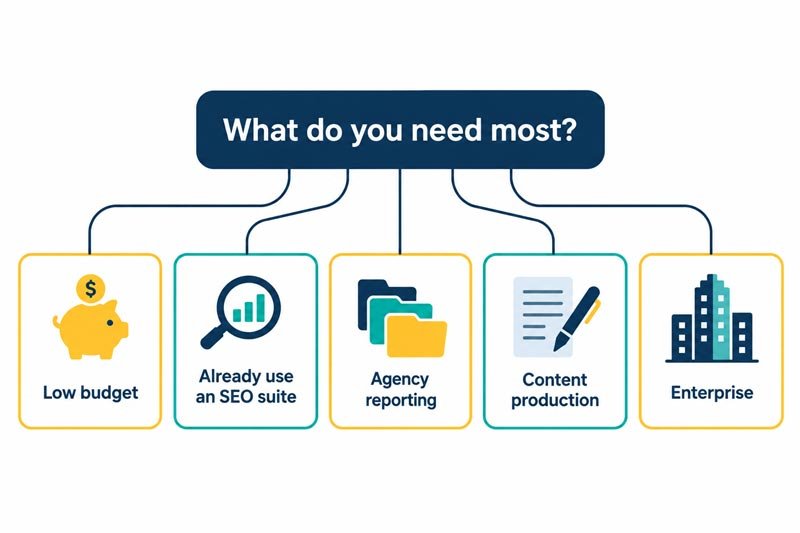
Start with your situation, not the ranking. Here’s a quick map.
| If you are… | Shortlist | Why |
|---|---|---|
| A freelancer or small team on a tight budget | OtterlyAI, AthenaHQ (free), RankScale | Low or zero entry cost, real citation data |
| Already paying for Semrush or Ahrefs | Semrush AI Toolkit or Ahrefs Brand Radar | No new workflow, AI data next to SEO data |
| An agency reporting to many clients | Peec AI, OtterlyAI, ZipTie, RankScale | Agency plans, exports, white-label or share links |
| A content-heavy team that wants fixes, not just data | AthenaHQ, Writesonic, Peec AI | Strong action workflows tied to content and PR |
| An ecommerce brand | Peec AI, Profound, AthenaHQ, Scrunch, RankScale | They document shopping or commerce tracking |
| A large enterprise with security needs | Profound, AthenaHQ, Scrunch | Governance, agent analytics, enterprise controls |
Here’s one more piece of advice: when asking the various vendors, find out where their data comes from-whether it’s from the live consumer interface, an API, an indexed corpus, or a combination of these-the answer will affect what you’re actually measuring.
A 7-step trial checklist
With most of these tools you get either a trial version or a free plan; make good use of it by running the same test on two or three of the tools at the same time.
- Write 20 to 30 prompts. Mix branded, non-branded, comparison, problem-based and buying-intent questions.
- Add your real markets. Include the countries, languages and product lines that drive revenue.
- Add 3 to 5 competitors. Share of voice means nothing without them.
- Record the basics. Visibility, mentions, citations, sentiment and which sources get cited.
- Test the boring stuff. Exports, scheduled reports, user seats and integrations.
- Price your real setup. Count engines, prompts, refresh rate, users, add-ons and overages.
- Run it on several dates. AI answers shift. One snapshot isn’t a trend.
Final verdict
If you’re looking for the best all-round tool and need honest, public pricing, go with Peec AI. Should you already use Semrush as your SEO tool, then choose Semrush. If you’re just trying things out, opt for OtterlyAI or AthenaHQ’s free plan. Make your choice of Profound if importance to you is depth rather than price.
The remaining five are not just filler; ZipTie comes out ahead in terms of spend control, Writesonic is the winner for content teams, Ahrefs leads in search context, Scrunch excels at the technical level, and RankScale wins in price and range.
No matter what decision you make, keep the following in mind: the tool itself merely measures; the actual work involves correcting what it identifies, such as improving the content, strengthening the citations, and ensuring the site can be understood by AI bots.
FAQs
What is an AI visibility tool?
It is software which keeps record of how frequently AI services such as ChatGPT, Gemini, Perplexity and Google AI Overviews mention or cite your brand. Most of these tools also monitor competitors, sentiment and the sources that the AI engines depend on.
What is the best AI visibility tool in 2026?
Peec AI came out on top in our review with a score of 88 out of 100; it achieves a good balance between tracking depth, action suggestions, integrations, and public pricing. However, the best tool for you will still come down to your budget and the SEO tools you are currently using.
Is there a free AI visibility tool?
AthenaHQ provides a free Essential plan which includes 300 credits, while OtterlyAI, Profound, and ZipTie as well as Scrunch have free trials; however, Semrush states that its AI Visibility Toolkit does not offer a free trial.
How much do AI visibility tools cost?
The monthly prices for the entry plans listed by us go from $20 to $295, the median price being $95. Enterprise plans are generally custom-made and the actual cost can be increased by adding engine add-ons, extra prompts or obtaining API access.
