

Run 15 prompts in five groups to check if ChatGPT knows your brand. They test brand facts, category visibility, comparisons, accuracy and sources. Use a fresh logged-out chat and run each prompt three times, because AI answers change between runs. Then score what you find and fix the gaps.
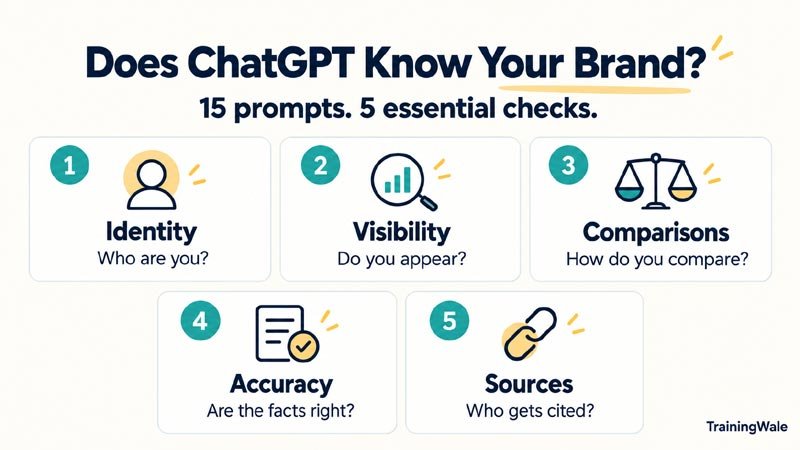
You’ve checked your Google rankings a hundred times. Have you checked what ChatGPT says about you?
Most brands haven’t. And that’s risky, because ChatGPT now answers questions your customers used to type into Google.
OpenAI reported 900 million weekly ChatGPT users in February 2026. India alone has 100 million weekly users, OpenAI’s second-largest market. (LLM Pulse, Unite.AI)
Below are 15 copy-paste prompts I use in brand audits. Replace the words in square brackets, run them, and you’ll know where you stand in about an hour.
Why This Check Matters Now
| Data point | Source |
|---|---|
| 57% of US shoppers who use generative AI use it for product research. | Omnisend survey of 1,224 US consumers (2025) |
| Branded web mentions correlate at 0.664 with brand visibility in ChatGPT. | Ahrefs study of 75,000 brands (Dec 2025) |
| 53.7% of product categories in ChatGPT have no clear leading brand yet. | Semrush study of 50,000+ brands (Jul 2026) |
| The same prompt can show a brand 9 times out of 10, or only 4 times out of 10. | Conductor, 14,000 API calls (2026) |
| 62% of wrong AI answers about brands came from outdated information. Only 11% were invented. | Timmermans Media, 1,917 answers (Jul 2026) |
The two numbers mentioned here ought to cause you to alter the way you test.
First of all, in more than half of the categories there is no clear winner with respect to ChatGPT, which means that the position is still up for grabs in most markets, including possibly yours.
Secondly, the way AI responds is inconsistent. One test doesn’t tell you much; you have to run each prompt more than once.
Set Up a Fair Test First
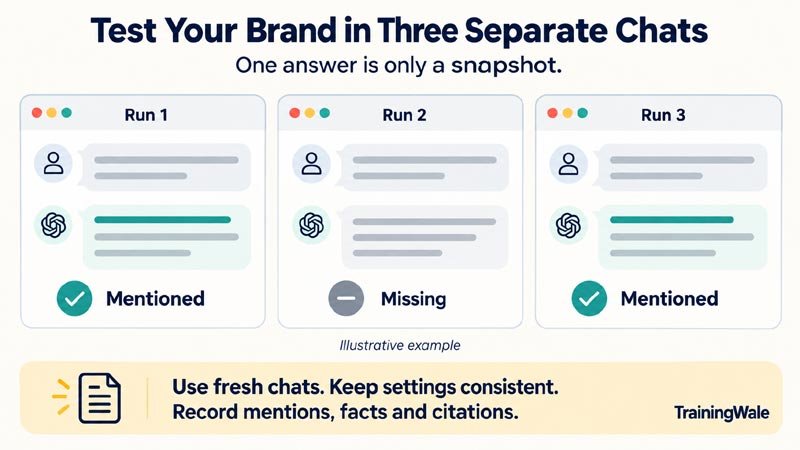
ChatGPT keeps track of you; if you have previously discussed your brand then it might give you a preference, which could lead to a false sense of comfort.
- Use a clean session. Log out, or use a Temporary Chat with memory turned off.
- Keep search on. ChatGPT search pulls live web results, which is how most users see it now.
- Run each prompt three times. Start a new chat each time.
- Record everything. Note the date, whether your brand appeared, its position and the sources cited.
- Test other engines too. Run the same prompts on Gemini and Perplexity if you have time.
When you come to the prompts listed below, substitute your own information for [Brand], [Category], [City] and [Competitor].
Group 1: Does ChatGPT Know Who You Are?
These prompts are designed to check whether ChatGPT regards your brand as a real entity; if it gets them wrong, then nothing else is of any importance at all.
Prompt 1: The basic identity check
What is [Brand]? Tell me what it does, who founded it, where it’s based and when it started.
What to look out for is the wrong founders, the wrong city, or a confusion with a similar-sounding brand, since name confusion is common among Indian brands that have generic names.
Prompt 2: The offer check
What products or services does [Brand] offer, and who are they for?
What to look out for is missing items, products that have been discontinued, and targeting the wrong audience; if ChatGPT includes a service which you stopped offering two years ago, it’s because your old pages are still providing it with information.
Prompt 3: The reputation check
Is [Brand] a trustworthy company? What do customers say about it?
What to look for is the reviews it quotes and the sources thereof. Once an angry Reddit thread has appeared, it can influence this answer for months.
Group 2: Do You Show Up When Buyers Don’t Name You?
The most important group are the ones who actually have a need and don’t type your brand name.
Prompt 4: The category list
What are the best [Category] companies in [City] in 2026?
What to look for is whether or not you are listed and your position within the list; being fifth in a list of five still qualifies. The actual issue is not appearing at all.
Prompt 5: The problem-first query
I need help with [problem your product solves]. Which companies or tools should I consider?
What to look for is whether ChatGPT associates your brand with the problem rather than just the category, since that’s the way most actual users ask.
Prompt 6: The specific buyer query
Which [Category] is best for [specific audience, e.g. small businesses in India] on a tight budget?
What to look for is whether or not you succeed in your particular niche, since smaller brands tend to lose out on broad lists but manage to win with narrow ones.
Group 3: How Do You Compare?
Comparison prompts are the most stable type. Conductor found that the leading brand remains in the first position 91$ of the time in the case of comparison prompts. Therefore, these results are worth taking seriously.
Prompt 7: The head-to-head
Compare [Brand] with [Competitor] on price, features and customer support. Which should I choose and why?
What to look for is who is declared the winner and the reasons provided for this, since these reasons reveal what the web thinks about you.
Prompt 8: The alternatives check
What are the best alternatives to [Competitor]?
What to look for is whether you are positioning yourself as an alternative to your main rival. This is a high-intent question, the people who ask it being ready to switch.
Prompt 9: The strengths and weaknesses check
What is [Brand] better at than its competitors, and where is it weaker?
What to look for are the weaknesses, in particular. Whenever they are outdated or unfair, you will know which story needs to be corrected.
Group 4: Are the Facts Right?
The positive point is that AI seldom comes up with facts from nothing. The negative point is that it usually repeats existing ones.
Prompt 10: The pricing check
What are [Brand]’s current prices or plans? Please include the date of your information.
What to look for are old prices and old plan names. Timmermans Media discovered that on 6.8% of the questions the prices were incorrect. Most of those errors were due to the information being outdated rather than having been made up.
Prompt 11: The leadership and size check
Who leads [Brand] today, and how big is the company in terms of customers, locations or team size?
What to look for is a former CEO, or outdated branch figures or old customer figures. Investors and partners frequently use this exact query.
Prompt 12: The risk check
Are there any complaints, controversies or problems with [Brand] that I should know about?
What to look for is that closed issues are being shown as if they are still current. Although this situation is awkward, your customers are already raising this question.
Group 5: Where Does ChatGPT Get Its Information?
The prompts indicate which sources influence the story of your brand, so that’s where you should make the necessary adjustments.
Prompt 13: The source check
What websites or sources did you use for your answer about [Brand]? List them with links.
What to look for is whether or not your own website shows up at all; in many cases, review sites, directories and news sites rank higher than the brand itself.
Prompt 14: The trusted sources check
Which websites, evaluation platforms or forums would you trust most to research [Category] companies?
What to do is to identify the platforms that ChatGPT mentions. If you aren’t active on those platforms, then that is your list of targets.
Prompt 15: The gap finder
What information is missing or unclear about [Brand] that would help you recommend it more confidently?
What to look for are honest gaps, for example missing pricing, an unclear target audience or a small number of reviews. Although ChatGPT’s response won’t be perfect, it usually directly identifies your weakest content.
Include an anecdote about a brand audit in which one of these prompts brought something surprising to light, for example, an incorrect founder, an outdated price, or a competitor winning by default.
How to Score Your Results
Take the answers and score them, so that you can keep an account of your progress on a monthly basis.
| What to score | 2 points | 1 point | 0 points |
|---|---|---|---|
| Mentioned (prompts 4 to 8) | In all 3 runs | In 1 or 2 runs | Never |
| Position in lists | Top 3 | 4th or lower | Not listed |
| Facts (prompts 1, 2, 10, 11) | All correct | Minor errors | Major errors |
| Own site cited (prompt 13) | Cited first or second | Cited lower down | Not cited |
| Tone (prompts 3, 9, 12) | Positive | Neutral or mixed | Negative or outdated |
An 8 or 10 indicates that ChatGPT knows you well, a score between 4 and 7 shows that there are obvious gaps, and below 4 means that ChatGPT barely knows you exist.
Then what would your brand’s score be today?
What to Do If ChatGPT Gets You Wrong
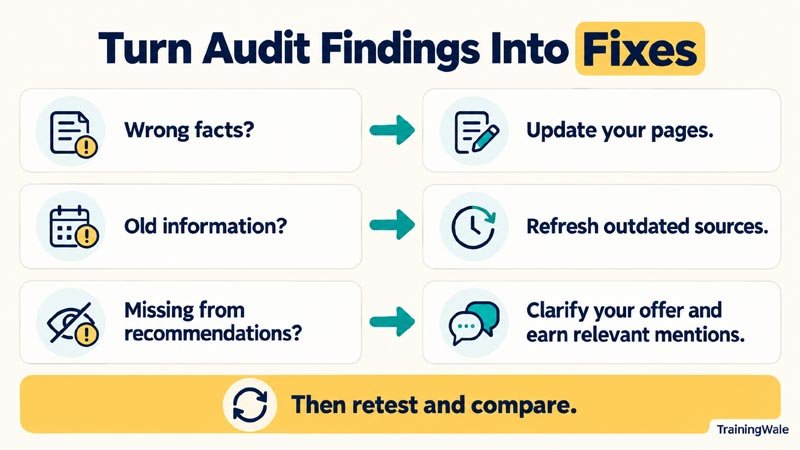
That’s my straightforward opinion: you cannot directly edit ChatGPT’s answer, only the information that appears on the web about you.
- Fix your own pages first by putting the current prices, the leaders, and the key figures onto HTML pages and making sure they have a clearly visible “last updated” date.
- Remove or update old pages. Since most wrong answers come from obsolete data, old pages are your biggest risk.
- Earn references, not just links. Ahrefs discovered that branded web references are a better predictor of AI visibility than backlinks, with mentions on YouTube showing the highest association, amounting to about 0.737.
- Go to the places where ChatGPT is present. Use the responses you give to prompts 13 and 14 as a list of targets for reviews, directories and press releases.
- Choose a narrow topic. Semrush discovered that topic leaders maintain their position first place 90.4% of the time from one month to the next. Win one topic completely before moving on to the entire category.
- Use schema markup appropriately.
If you want to know why ChatGPT selects some brands and not others, then read how ChatGPT picks brands to mention. For an actual example of this test applied to Indian banks, refer to our small finance banks AI readiness study.
If you prefer that we track it automatically, you can compare the options in our list of the best AI visibility tools.
Key Takeaways
- Run 15 prompts in five groups: identity, category, comparison, facts and sources.
- Always test in a clean, logged-out chat. Your own chat history can make results look better than they are.
- Try the prompt three times. The Conductor found that the same prompt could show a brand either 9 out of 10 times or only 4 times.
- Most wrong answers about brands come from outdated information, not invented facts.
- 53.7% of ChatGPT categories have no clear leader yet, so there’s still room to win.
- You fix ChatGPT’s answer by fixing your pages and earning mentions on sites it trusts.
Frequently Asked Questions
How often should I check what ChatGPT says about my brand?
For most brands once a month is sufficient, though you should check more frequently following a major change such as a new pricing strategy, a rebranding or a change in leadership.
Why does ChatGPT give different answers to the same prompt?
Each answer produced by AI models is generated fresh and the search results vary. A study by SparkToro showed that there is less than a one in 100 chance of obtaining the same list of brands on two occasions. (MediaPost) That is why it is necessary to run each prompt three times.
Can I ask OpenAI to correct wrong information about my brand?
There is no option for directly editing brand facts; the best solution is to update your own website as well as the third-party sites that ChatGPT references, since its answers will eventually match the information on the web.
Do these prompts work on Gemini and Perplexity too?
Right, all 15 prompts will work with any AI assistant, although the results may vary depending on the engine used, so it’s a good idea to test two or three of them.
Is ChatGPT visibility more important than Google rankings?
Not yet. Google still sends most website traffic. But ChatGPT increasingly shapes which brands people trust before they search, so you need both.
