

Search changed. People used to type a query, scan ten blue links, and click. Now many of them ask an AI tool and read the answer. They never reach your site.
This shift created two new terms next to SEO: AEO and GEO. A lot of marketers use them as if they mean the same thing. They do not.
Here is the plain breakdown, with side-by-side tables and a short action plan for each.
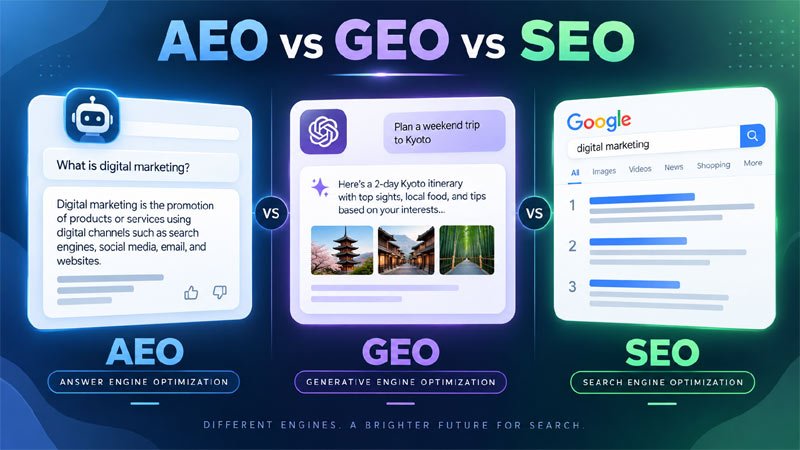
SEO helps your pages rank in search results. AEO helps your content get picked as the direct answer in snippets and answer boxes. GEO helps your brand get mentioned and cited inside generative AI tools like ChatGPT, Gemini, Claude and Perplexity. They share one foundation. The difference is where you show up, and how the machine uses your content.
| Term | Full form | Goal in one line |
|---|---|---|
| SEO | Search Engine Optimization | Rank higher in search results and earn the click. |
| AEO | Answer Engine Optimization | Become the direct answer, not just a link. |
| GEO | Generative Engine Optimization | Get named and cited inside AI-generated answers. |
Why this matters now
The scale is real and cannot be ignored. Here is what the data shows.
- ChatGPT reached about 900 million weekly active users by early 2026. It rose from 400 million a year earlier, and was nearing a billion by mid-year. It handles more than 2.5 billion prompts a day. Source
- Google’s own AI Overviews now reach more than 2.5 billion monthly users, and its AI Mode passed 1 billion monthly users within a year. The data is based on Google at I/O 2026. Source
- AI Overviews now appear on more than 20% of Google searches. The share is rising. When one appears, organic click-through drops by close to 60%, per SparkToro. Source
- Around 60% of US Google searches ended without a single click in 2026. Source
- AI referral traffic to US retail sites grew about 693% year over year during the 2025 holiday season, as per Adobe. Source
Read that again. Your buyers are getting answers before they reach your website. If your brand is missing from those answers, you lose the sale and never see it in your analytics.
SEO: optimizing to rank in search results
SEO is the discipline you already know. You optimize a page so a search engine ranks it well. Then a person clicks and lands on your site.
SEO rests on three things: technical health, relevant content, and authority through links. It is still the base layer. AI engines crawl and read the open web, so a page that search engines cannot access is invisible to AI too.
SEO is not dead. But ranking alone no longer guarantees visibility. A page can sit at position one and still be left out of the AI answer above it.
Google’s own position is that its AI features are built to send people to the open web. It says it has added more inline links inside AI responses to push clicks to sites. Source
AEO: optimizing to be the answer
AEO is about being the answer, not just a result.
Think featured snippets, People Also Ask, voice search, and the short answer boxes that AI tools show. The engine reads your page, pulls one clean chunk, and shows it as the response.
To win at AEO, you need to write in a way machines can take the content and use it in their answers. State the answer first. Keep it short. Use distinct headings that match real questions. Add structured data so the engine understands what each block means.
AEO is older than GEO. Featured snippets have existed for years. The skills carry straight over to AI answers.
GEO: optimizing to be cited by AI
GEO is the newest of the three. It targets generative engines: ChatGPT, Gemini, Claude, Perplexity, and Google’s AI Overviews and AI Mode.
These tools do not just show a link. They read many sources, blend them, and write a fresh answer. Your goal is to be one of the sources they trust, name and cite.
GEO is broader than AEO. It covers your own pages, but also what the wider web says about you. Reviews, mentions, comparisons, data and PR all feed what an AI learns about your brand.
One more point. GEO is not a single-engine game. ChatGPT still leads AI referrals, but Claude, Gemini and Perplexity now hold real share, per Similarweb. Source Optimizing for one tool reaches a shrinking slice of the audience.
How SEO, AEO and GEO compare
| Factor | SEO | AEO | GEO |
|---|---|---|---|
| Main goal | Rank and earn the click | Be the direct answer | Be mentioned and cited by AI |
| Where you appear | Search result links | Snippets, PAA, answer boxes | Inside AI-generated answers |
| Who reads your content | A person, after clicking | A person, often without clicking | An AI model, then a person |
| Main engines | Google, Bing | Google, Bing, voice, AI boxes | ChatGPT, Gemini, Claude, Perplexity, Google AI |
| Content format | In-depth pages | Answer-first, concise blocks | Quotable, evidence-rich, well-structured |
| Key signals | Keywords, links, technical health | Structure, schema, clear answers | Retrievability, authority, citations, entity signals |
| Off-site weight | Medium (backlinks) | Low | High (mentions, reviews, PR) |
| Success looks like | Higher rankings and traffic | Owning the snippet | Getting named as a source |
Where they overlap
These are not three separate jobs. They stack.
Good SEO makes your page crawlable and trusted. That same page is easier for AEO to feature and for GEO to cite. Clean structure helps all three. Strong authority helps all three.
So you are not choosing one and dropping the rest. You are extending SEO upward into answers and AI citations.
Three things help across SEO, AEO and GEO:
- Content that clearly answers a real question.
- Structure and schema that computers can parse.
- Authority signals that prove the brand is a credible source.
Which AI crawlers should you know?
Each AI company runs separate bots for training, search and live fetches. Block the wrong one and you can vanish from AI answers.
| Crawler | Company | What it does | If you block it |
|---|---|---|---|
| Googlebot | Crawls for Search, AI Overviews and AI Mode | You drop out of Google, AI features included | |
| Google-Extended | Controls use of your content for Gemini training | No effect on Google Search inclusion | |
| GPTBot | OpenAI | Collects content that may train OpenAI models | Training skips you. ChatGPT search is a separate control |
| OAI-SearchBot | OpenAI | Surfaces sites in ChatGPT search | Your pages won’t appear in ChatGPT search answers |
| ChatGPT-User | OpenAI | Fetches a page when a user asks ChatGPT to | OpenAI says robots.txt rules may not apply |
| ClaudeBot | Anthropic | Collects training data | Training skips you |
| Claude-SearchBot | Anthropic | Indexes pages for Claude’s search answers | Fewer Claude citations |
| PerplexityBot | Perplexity | Indexes pages for Perplexity answers | Few Perplexity citations |
My advice for most businesses is simple. Block GPTBot if you dislike training use, but keep OAI-SearchBot open. Bot names change, so check OpenAI’s crawler documentation and each vendor’s docs before you edit robots.txt.
Does SEO still matter in 2026?
Yes, SEO still matters. Google says its AI features sit on its core ranking and quality systems.
In a guide published on May 15, 2026, Google said optimizing for AI Overviews and AI Mode is still SEO. The guide also lists tactics Google doesn’t need, like llms.txt files and AI-only markup.
The pressure is real, though. In February 2024, Gartner predicted that traditional search engine volume would drop 25% by 2026.
“Generative AI (GenAI) solutions are becoming substitute answer engines.”
Alan Antin, Vice President Analyst, Gartner
Clicks show the strain. An Ahrefs study of 300,000 keywords found AI Overviews cut the top result’s click-through rate by about 34.5%. It compared March 2024 with March 2025.
In June 2024, organic results received clicks on 1.76% of searches that showed an AI Overview. By September 2025, that figure was down to 0.61%. These numbers come from Seer Interactive’s study of 3,119 informational queries across 42 organizations.
Brands cited in those AI Overviews had a 35% higher organic click-through rate than brands that weren’t cited. That doesn’t prove the citation caused the difference, but it’s worth investigating.
I’ve spent more than 20 years in this field, and the “SEO is dead” claim keeps coming back. My advice is still to get the SEO basics right. AEO and GEO add things to work on, but useful pages and a website search engines can crawl still matter.
What to do about each, starting this week
For SEO
- Fix crawl and speed issues so engines can read every page. This becomes more important for websites that are made using JS.
- Target real search intent, not just keywords.
- Earn links from relevant sites.
For AEO
- Put the answer in the first line under each heading.
- Turn headings into the exact questions people ask.
- Add FAQ and how-to schema where it fits.
For GEO
- Run your buyer’s question across ChatGPT, Gemini, Claude and Perplexity. See if you show up.
- Add clear facts, data, and sources that an AI can quote.
- Build off-site presence. It includes reviews, mentions, comparisons, and PR among others.
- Strengthen entity signals. This way AI will know who you are and what you do.
Which one should you focus on
Start with SEO. It is the base. Without it, AEO and GEO have nothing to stand on.
Then add AEO. It is a small step from good SEO, and it wins visibility even on zero-click searches.
Then invest in GEO. This is where search is heading, and very few agencies can deliver it yet. Brands cited in AI answers already earn about 35% more organic clicks than uncited brands on the same query, per Seer Interactive. Source The early movers are building an advantage now.
If you run an agency or work as a consultant, GEO is also a service you can sell today. Most competitors cannot. That gap is the opportunity.
Learn to do this on a real business in 5 days
Reading about GEO is one thing. Doing it is another.
TrainingWale runs a hands-on 5-day AEO and GEO sprint for SEO and content professionals. You pick one real business on Day 1 and work on it all week. You finish with a client-ready strategy pack: an AI visibility baseline, an on-page and technical audit, a query map, an authority plan, and a 90-day roadmap.
See the full day-by-day plan on the 5-day AEO and GEO curriculum page.
Frequently asked questions
What is the difference between SEO, AEO and GEO?
SEO helps your page rank in search results. AEO helps your content become the direct answer in snippets and answer boxes. GEO helps your brand get mentioned and cited inside AI answers from tools like ChatGPT and Gemini.
Is GEO replacing SEO?
No. GEO sits on top of SEO. AI engines read the open web, so a page that is not crawlable or trusted will not get cited. Strong SEO makes GEO possible.
What is AEO in simple words?
AEO means writing your content so a search or AI engine can lift a clean, short answer straight from your page and show it as the response.
What is GEO in simple words?
GEO means crafting both your pages and your wider web presence so AI tools trust your brand enough to name it and cite it in their answers.
Do I need to do all three – AEO, SEO, and GEO?
Yes, if you want full visibility. All three share the same foundation and support each other. Start with SEO, add AEO, and then you can build GEO.
Which one matters AEO, SEO, or GEO most in 2026?
SEO is the base. GEO is the fastest-growing gap in digital marketing right now and the hardest for competitors to copy. This makes it the biggest opportunity right now.
Key Takeaways
- SEO helps people find your pages in search. AEO helps your content answer their questions. GEO aims to get your brand mentioned or cited in AI answers. AIO is a more general term for helping AI systems understand and trust your business.
- Google says the same SEO basics apply to AI Overviews and AI Mode.
- Many AI crawlers cannot read content loaded through JavaScript. Make sure your main text’s available in the page’s HTML.
- You can block GPTBot to limit crawling for training models. Keep OAI-SearchBot allowed if you want your site to be eligible for ChatGPT search.
- Ahrefs studied 75,000 brands and found that web mentions had a stronger link with AI Overview visibility than backlinks did.
